
ROSEAU: an umbrella that bends but does not break
ROSEAU is my personal design project. I wanted to rethink the link between an umbrella's rib and its stretcher, so that one gust too many no longer costs an umbrella but only a "click". I carried it out alone in autumn 2026, from the need to a mock-up that is modelled, sized and ready to print.
The viewer above shows the assembly in an exploded view, with a button to see it assembled and another to download the 9 STL files. The manufacturing and assembly guide and the set of drawings are further down, in the documents.
The problem
Ten million umbrellas are thrown away every year in France and about a billion worldwide. Made of plastic, steel and nylon crimped together, they are almost never recycled. Repairers agree on the typical failure. The joint between the rib and the stretcher, or its rivet, breaks exactly where a gust concentrates the load. Existing "storm" umbrellas hold up by being stiffer, heavier and more expensive, and they cannot be repaired.
The need
Instead of the "bull's-eye" diagram, I described the need through the elements of the outside environment, drawn as an octopus diagram. From it I drew two main functions, protecting the user from rain and keeping them protected despite gusts, without damaging the product. The quantified specification sets the target. There must be no deformation up to 50 km/h, no part broken or thrown off at 100 km/h, a return to service in under 10 s, under 50 N and without tools, and an extra cost under 1 EUR.
From cause to solution
I listed thirteen causes of breakage with an Ishikawa diagram, then ranked them by criticality in a Pareto chart. The rigid link with no fuse element and the riveted joints alone account for 47% of the criticality, and four causes make up 64%. Fifty brainstormed ideas, the inversion method ("how to make sure the umbrella breaks at the first gust?") and TRIZ analysis led me to a lead. It takes a link that gives way below a known threshold and then snaps back, like an electrical fuse or a ski binding with a calibrated release. I compared seven concepts sketched by hand with a weighted Pugh matrix. The fuse link comes first, and a second matrix picks the printed elastic clip among five fuse technologies.
The principle
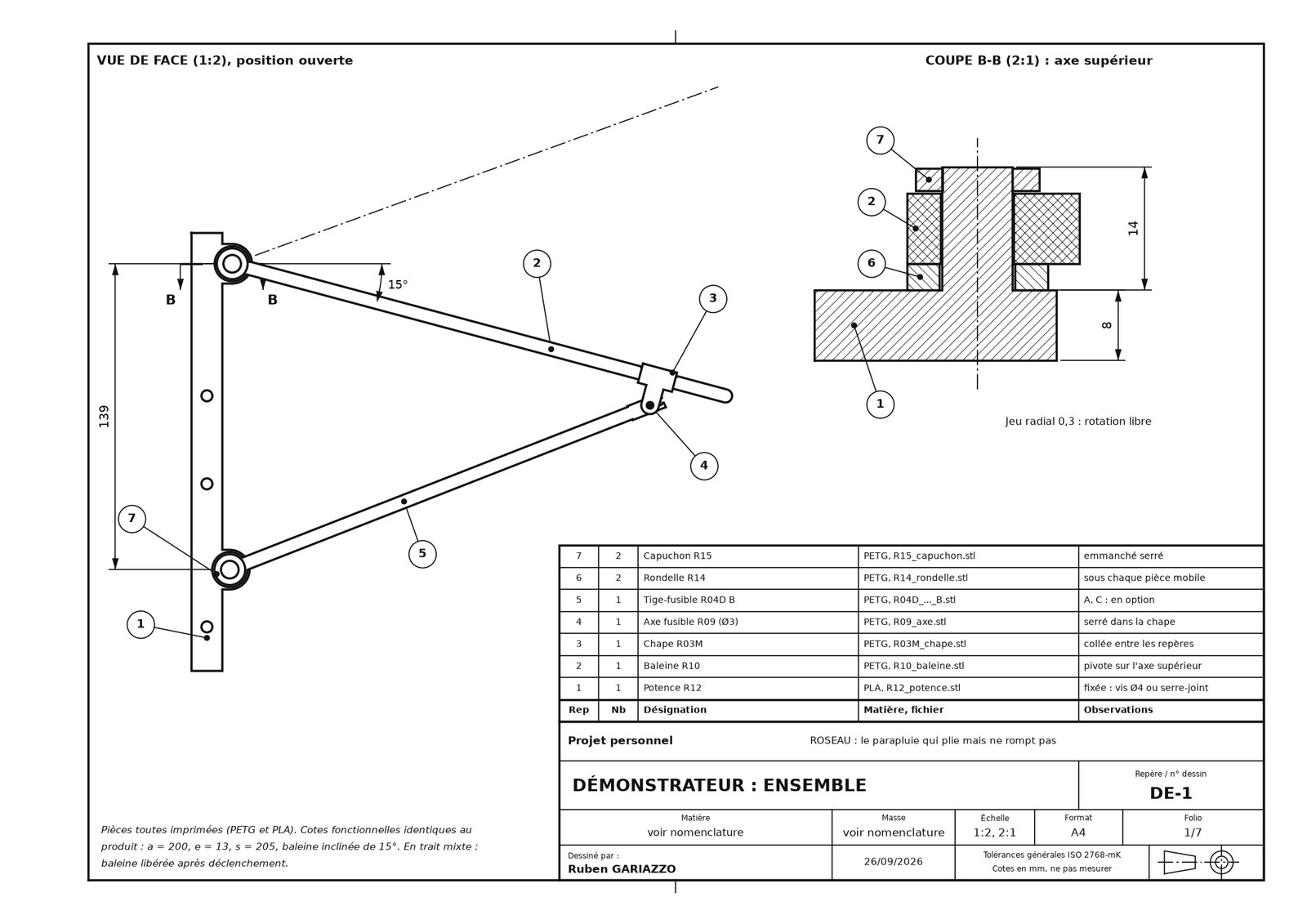
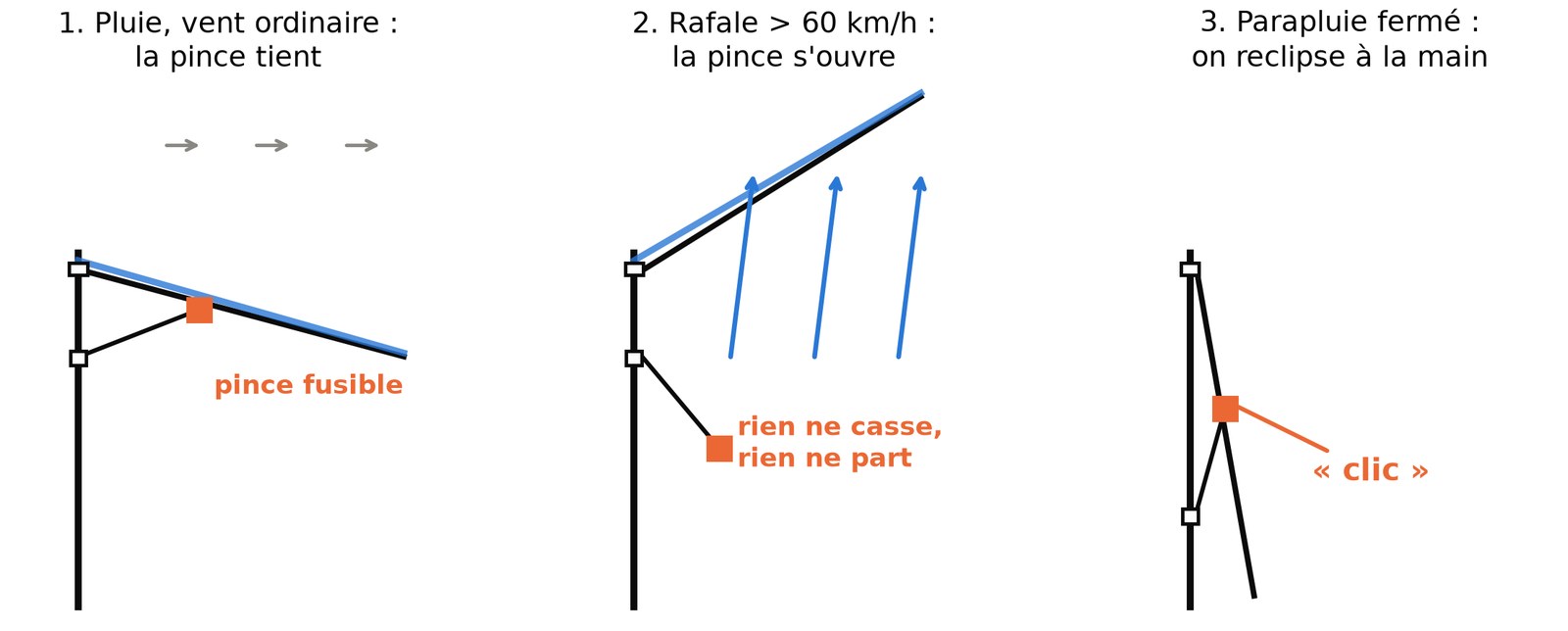
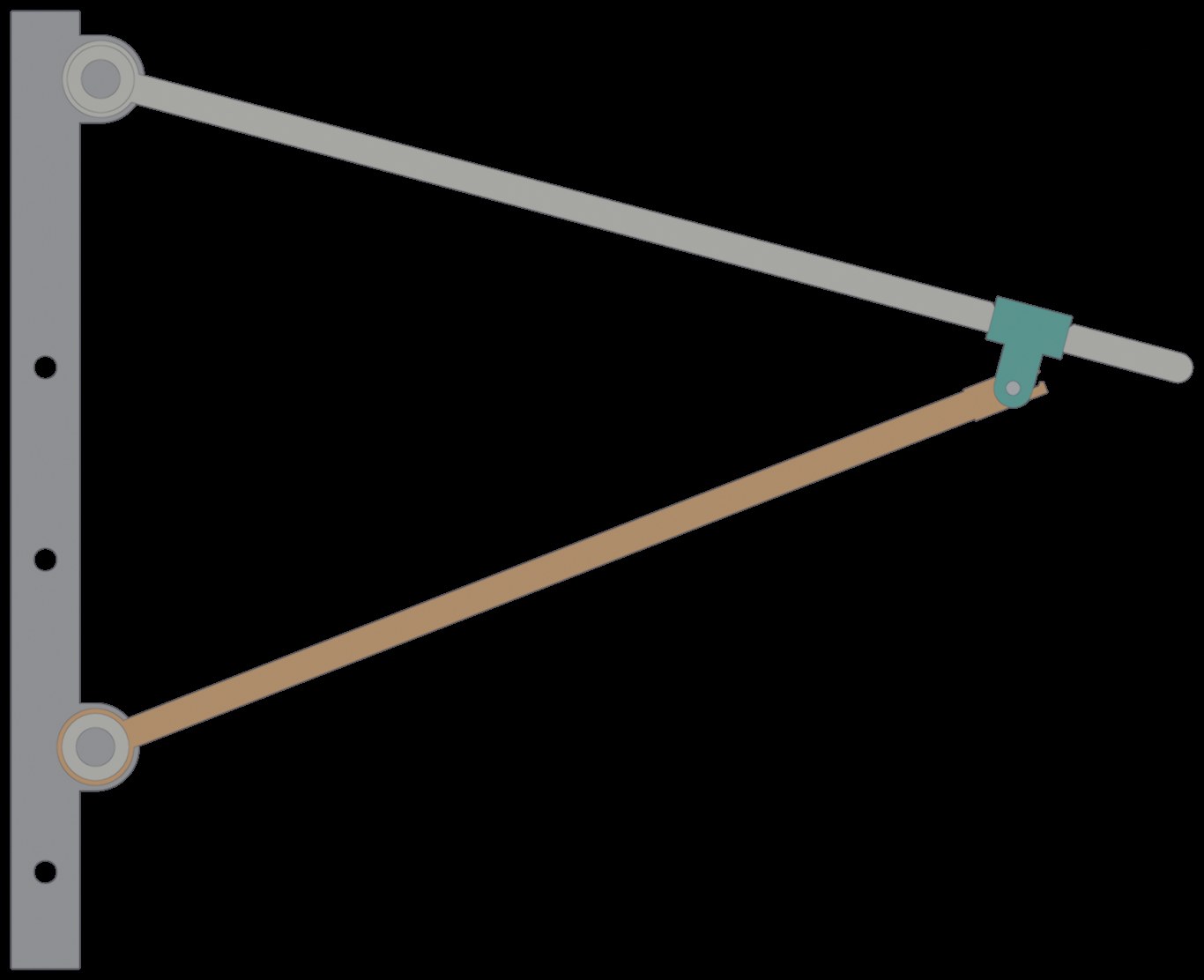
On each rib, a glued clevis carries a 3 mm steel pin. The return rod ends in a U-shaped elastic clip that snaps onto this pin. In ordinary wind, the clip transmits the opening force and the umbrella behaves like a standard one. When a gust lifts the canopy, the force in the rod rises. Beyond the threshold, the clip arms spread apart and the rib swings freely. Nothing breaks and nothing flies off. With the umbrella closed, you push the clip back onto the pin in one gesture.
The sizing
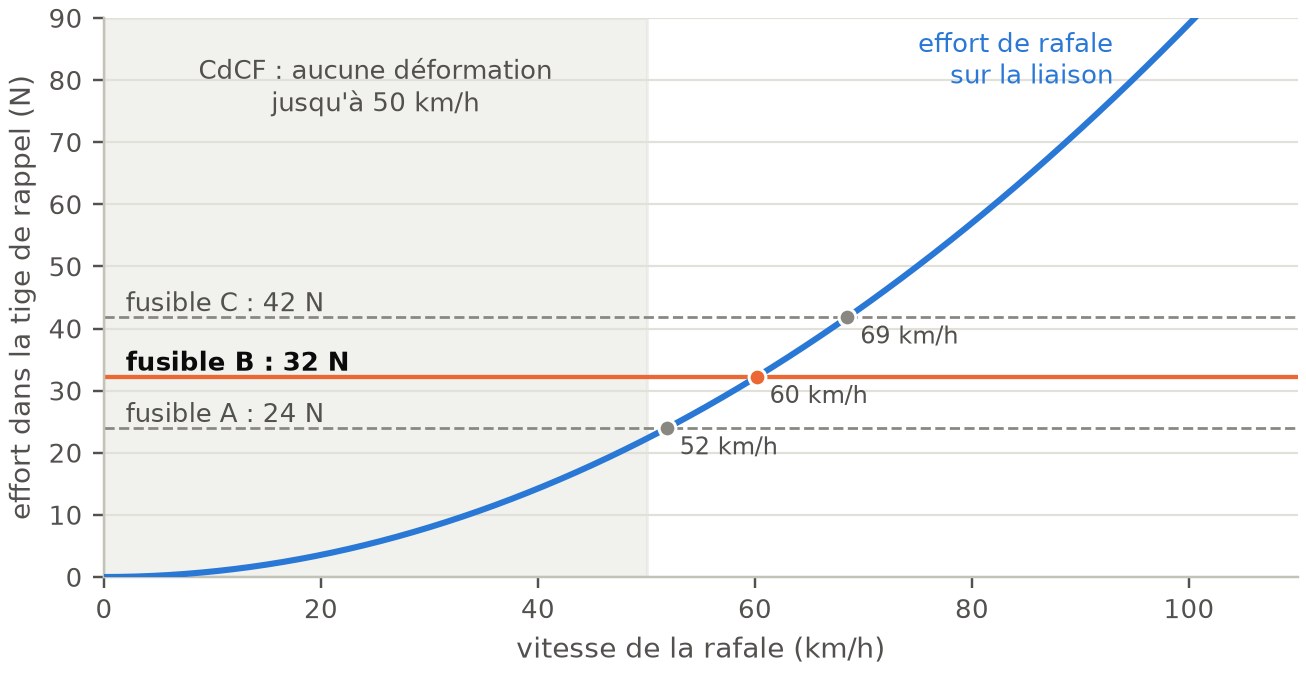
My sizing rests on an analytical model (simplified fluid mechanics and strength of materials), not on a finite-element simulation. At 50 km/h, the wind thrust on the share of canopy carried by one rib is 8.2 N, which means 22 N in the return rod. The force grows with the square of the speed and reaches 89 N at 100 km/h. Each clip arm is a PETG beam that must spread by 0.55 mm to release the pin, which gives an extraction threshold of 32 N, a release at about 60 km/h. Two other settings bracket it (24 N for 52 km/h, and 42 N for 69 km/h). The arm strain stays at 2.5%, below the 3% limit for a reusable clip, and rearming takes 32 N, under the required 50 N. Without the fuse, the stress in a fibreglass rib would reach 870 MPa at 100 km/h, above its strength.
The mock-up
The demonstrator reproduces one rib's fuse link at full scale, with a bracket, a shortened rib, a clevis, a pin and the fuse rod. It comes down to 9 printable parts in PETG and PLA, using about 67 g of filament. I modelled them parametrically, so the calculations, the dimensioned drawings and the print files share the same dimensions.
Limits and next steps
The validation is analytical. Every quantified requirement is met by calculation, but I present no physical test here. The threshold depends on the clip's friction on the pin, which is why I planned three lip-opening settings. The logical next steps would be a prototype with real fibreglass ribs, a version 2 with an adjustable ball and spring, and a repair kit (ribs, tips and clip-on fuses). The sources are listed in the report.
Documents
-
Project report (PDF, in French)
-
Dimensioned drawings (PDF)
-
Manufacturing and assembly guide (PDF, in French)